



A couple enjoys cocktails in the smoking lounge of an Imperial Airways Empire flying boat in the 1930s. Opening image: British Airways’ refreshed lineup for the Airbus A380-800

A Handley Page HP42 four-engine biplane airliner operated by Imperial Airways in the 1930s
2. Carriage in the sky
In 1931, Imperial Airways began operating the Handley Page HP42 – this time a four-engine biplane that debuted as the largest airliner in the world at the time. Customers traversing the Empire favoured comfort over speed, which is handy, given the plane flew at a genteel 100mph. Aboard the Handley they travelled in two luxurious saloons, each one bookending a central luggage hold, pantry and twin washrooms. The saloons were purposely bright and airy, with floral upholstered armchairs that echoed the finish of a Pullman railway carriage. Indeed, the quality of the seating was designed to encourage passengers to ditch train travel in favour of the skies.
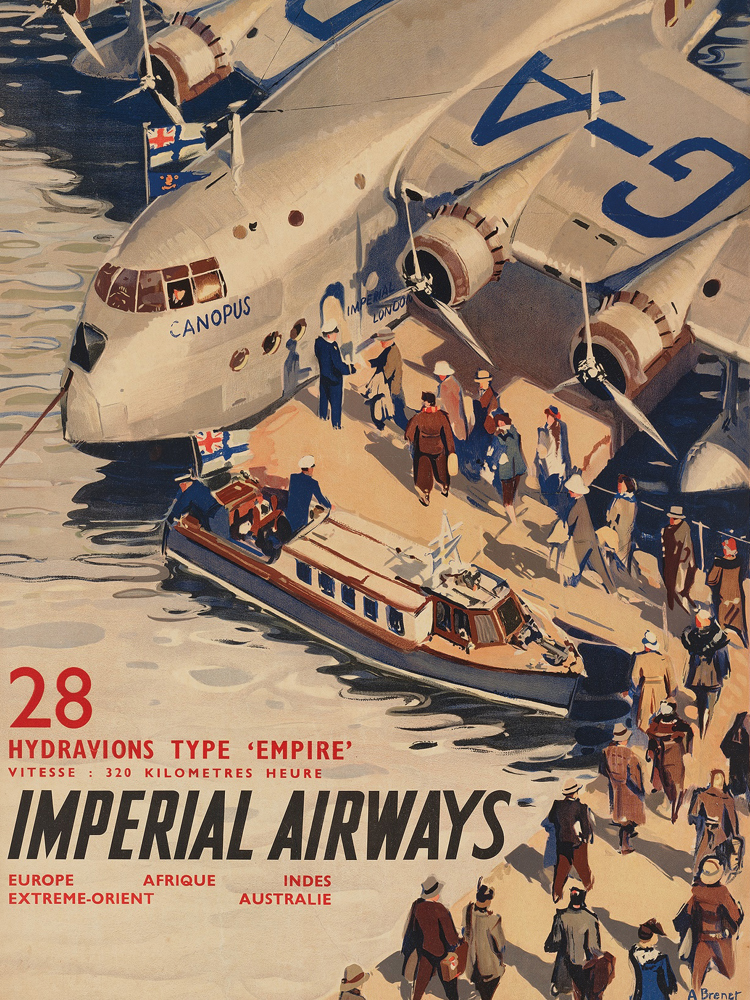
A vintage travel poster from around 1937 featuring the RMA Canopus, the first of Imperial Airways’ fleet of Short Empire flying boats
3. Water way to go
In 1936, Imperial Airways revolutionised long-haul travel with a fleet of 28 Empire flying boats – two-deck seaplanes designed for multi-day marathons from Southampton as far as Africa and Australia. Overnight hotel stays were baked into the fare, since the aircraft only flew during daylight hours. Engineered by Short Brothers, the seats themselves were exceptionally wide and plush, with high backs and integrated headrests that looked like giant Mickey Mouse ears for maximum comfort. They were arranged around a promenade deck where passengers could stand and take in high-altitude views from eye-level windows. Passengers also received a 100kg total weight allowance – although this, rather cheekily, included the weight of the passengers themselves.

Sleep comes easy aboard a BOAC Boeing 377 Stratocruiser during the early 1950s
4. The post-war pivot
In 1939, Imperial Airways merged into the newly formed British Overseas Airways Corporation (BOAC). The new era initially tested passenger endurance: on the 1945 London-to-Sydney route, travellers braved a gruelling 63-hour, five-stop journey in unpressurised Avro Lancastrians fitted with nine side-facing seats. In December 1949, VOAC took delivery of its first unprecedentedly luxurious Boeing 377 Stratocruisers. Deployed on its flagship ‘Monarch’ service between London and New York, these double-deckers featured a spiral staircase, a lower-deck bar and seats upholstered in ‘Corporation Blue’ Bedford cloth with leather armrests. At night, sleeper berths lowered from the ceiling. In Ian Fleming’s For Your Eyes Only, James Bond even lamented the plane’s retirement: “One had been able to have dinner in peace [and] sleep for seven hours in a comfortable bunk.”
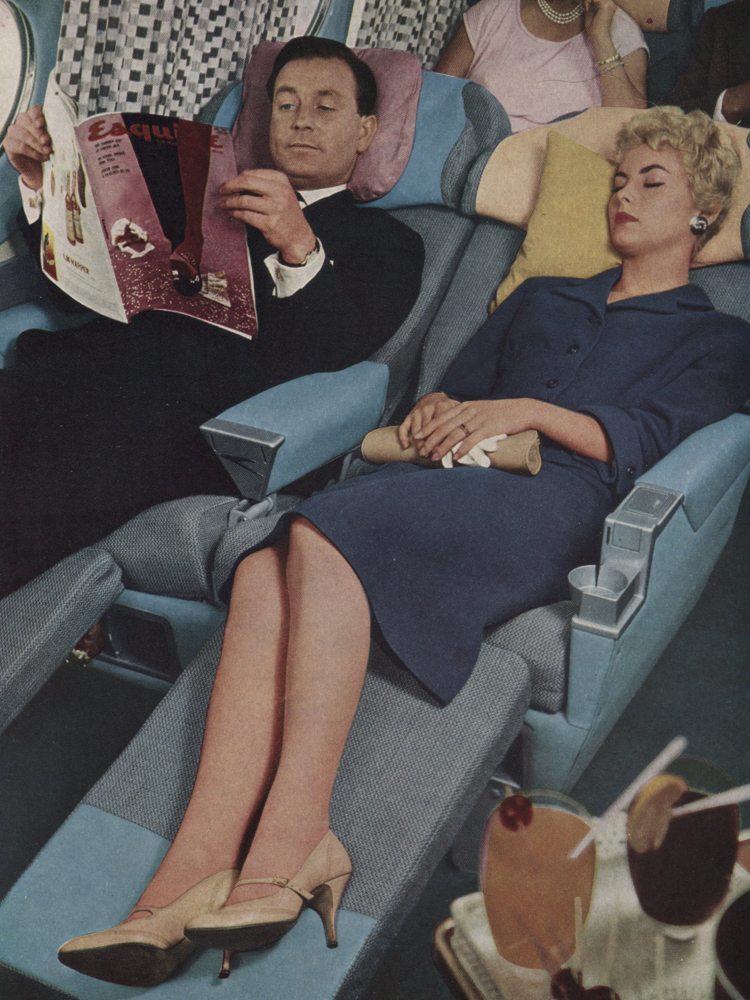
First-class passengers relax in reclining armchairs aboard a BOAC de Havilland Comet 4
5. Smooth operator
In October 1958, BOAC ushered in the Jet Age with its first transatlantic scheduled service by a pure jet transatlantic airliner: the de Havilland Comet 4, which would cut the Boeing 377 Stratocruiser’s travel time from London to New York nearly in half. To complement the aircraft’s legendary ‘vibration-free flying’, BOAC installed reclining ‘slumber-seats’ with a generous pitch and integrated leg rests. Built for high-altitude relaxation, all 36 seats on board had built-in ashtrays, glass holders, individual reading lights and an attendant call button. In a small first-class cabin, passengers were seated around tables, just like in a modern railway carriage. BOAC would continue to use the Comet 4s until 1965 – a surviving example of which you can still see today at the Imperial War Museum Duxford, near Cambridge.

The Club World ‘Cradle Seat’ was introduced on long-haul flights by British Airways in 1995

The British Airways Club World cabin featuring a ‘yin-yang’ staggered seating layout
7. A world first
‘Arrive ready to do business’ was the slogan of choice in May 1999, when British Airways unveiled its groundbreaking Club World seat. Billed as ‘a lounge in the sky’, the Club World cabin’s patented yin-yang seating configuration featured an armchair-style seat that transformed into six-foot, 180° fully flat bed – then a world first for any business class. Designed in total secrecy by design firm, Tangerine, each private suite was equipped with an integrated laptop power point, an in-arm satellite telephone and an expanded personal video screen. Electronic privacy screens were implemented between seats. This architectural leap also extended to the catering, with traditional trolley service scrapped in favour of restaurant-style dining.
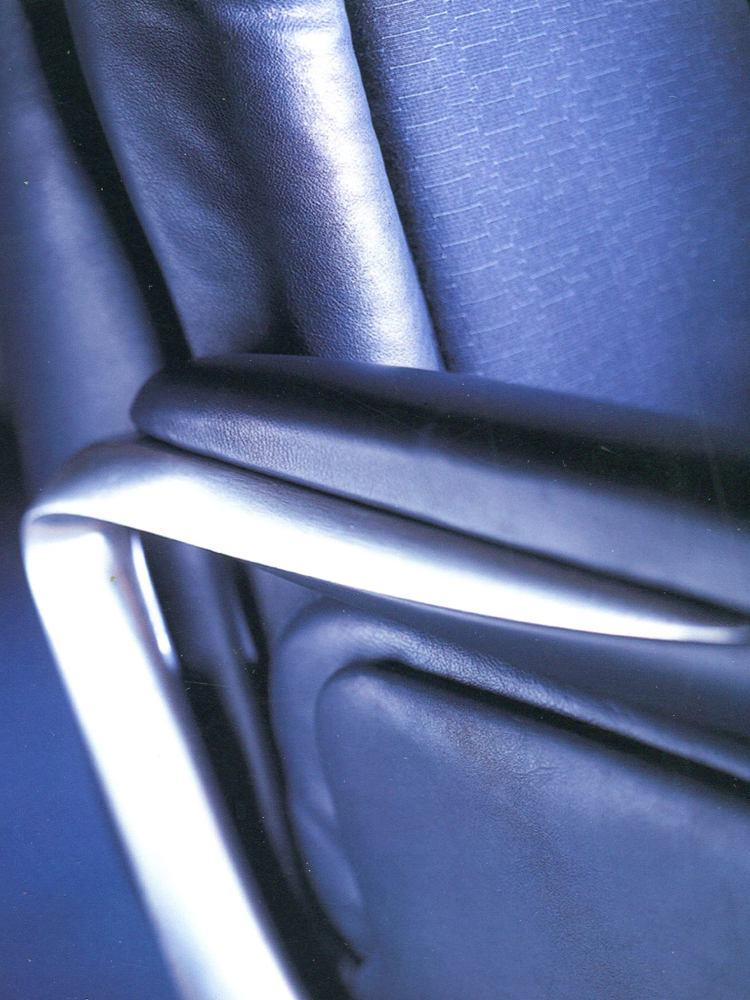
Passenger seat armrest and leather upholstery in the British Airways Concorde cabin, redesigned in 1999
8. Project rocket
Concorde was the supersonic pinnacle of style and, in 1999, British Airways commissioned London agency Factory Design, alongside design icon Sir Terence Conran, to execute ‘Project Rocket’ – a high-tech, lightweight seat worthy for the fleet. Constructed from an aluminium alloy and trimmed in supple Connolly leather, all 100 seats per aircraft were recontoured to reduce bulk and add a subtle cradle tilt mechanism, spring-loaded footrest, and an adjustable leather headrest. Tactile controls for seat recline and audio functions were integrated directly into the leather-wrapped armrests, which featured British Airways’ signature Speedmarque ribbon, laser-etched into the shiny metal end-caps.

British Airways’ new First suite is being rolled out on its retrofitted Airbus A380 fleet


